
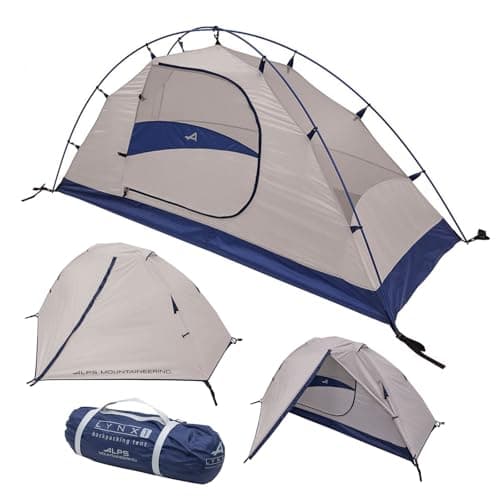
There's a specific kind of misery I know well: standing in a drizzle at a Cascades trailhead, staring at a stuff sack and wondering if the tent inside is going to hold up overnight. I'd already soaked through one shelter on a trip out near Mount Hood, and I was not in the mood to repeat that. So when I started looking for a solo tent that could handle PNW shoulder-season rain without requiring a second mortgage, the ALPS Mountaineering Lynx 1 kept coming up. I decided to give it an honest run.
We may earn from qualifying purchases.
Compared to what I'd used before
Before the Lynx 1, I was rotating between a budget two-person tent I'd borrowed indefinitely from a friend (heavy, slow to pitch, very much not mine) and a single-wall bivy that I truly hated whenever temps dropped and condensation turned the inside into a cold wet cave. Neither was a real solution for solo trips where I actually cared about sleeping.
The Lynx 1 comes in at 4 lbs. 1 oz. total weight, with a minimum weight of 3 lbs. 5 oz. That's not ultralight by any stretch. If you're a gram-counter building out a sub-10-lb. base kit, this tent is going to give you pause. But compared to most freestanding double-wall tents at this price point, it holds its own. I wasn't carrying a $500 shelter that I'd cry over if I caught a pole on a root.
The freestanding two-pole aluminum design is a real step up from the flexible fiberglass poles I'd wrestled with on cheaper tents. Aluminum flexes without snapping, and I've had fiberglass shatter on me in cold weather, so that matters. Setup is genuinely fast once you've done it twice.
Where it shines
Rain. That's the short answer. The rainfly uses a 1500 mm coating and the floor steps it up to 2000 mm poly taffeta. I've had the Lynx 1 out during some legitimately ugly overnight drizzle on the Ramona Falls trail corridor, and the floor stayed dry. The seams are factory-sealed, which I appreciate because I've absolutely forgotten to seam-seal a tent before a trip and paid for it.
The vestibule is small but real. I can tuck my boots and pack cover out there without them crowding my sleeping space. For solo overnights, that extra breathing room inside is noticeable, and the base footprint of 7'6" x 2'8" is genuinely just for sleeping, so keeping gear outside matters.
Ventilation is better than I expected. Half-mesh walls pull double duty: they keep bugs out on warmer nights when you're running the tent without the fly, and they move enough air to cut down on condensation when you do have the fly on. I still get some moisture buildup on cool mornings, but it's manageable and not the nightmare I dealt with in my old bivy.
The interior mesh pockets and gear loft are small touches that I've come to appreciate. My headlamp, phone, and earplugs always end up somewhere annoying if there's nowhere logical to put them. Here they have a home.
Check current pricing on the Lynx 1 on Amazon.
What I noticed first
Packed size. At 17" x 5", it fits lengthwise in or lashed to most standard backpacks. That's not revolutionary, but it's practical. I've owned tents that technically fit in my pack and practically made every trip a Tetris exercise. This one isn't that.
Setup speed was the second thing. With the freestanding design and two-pole system, I had it pitched in under five minutes on my first try. In the rain. Alone. That's the real test.
Now, my honest criticism: the interior width. At 2'8", it's snug. I'm not a big guy, and I still feel the walls when I roll over. If you're broad-shouldered or tend to move around in your sleep, you'll notice it. I found myself bumping the mesh walls on cool nights and then dealing with that moisture on my sleeping bag. It's not a dealbreaker, but it's the thing I'd want you to know going in. It's a true solo tent, not a "solo tent that doubles as a cozy two-person tent" like some listings imply.
The center height is listed at 3 feet, which is enough to sit up, change layers, and feel like a person. Not enough to stand, obviously, but that's fine. I knew what I was buying.
| Pros | Cons |
|---|---|
| Freestanding, fast pitch | Very narrow interior (2'8"), tight for broader sleepers |
| Factory-sealed seams, solid floor waterproofing | 4 lbs. 1 oz. total weight isn't ultralight |
| Aluminum poles hold up in cold and flex | Vestibule is functional but compact |
| Half-mesh walls reduce condensation | No included footprint |
| Compact packed size (17" x 5") | Color/style options are limited |
| Vestibule, gear loft, and mesh pockets included | Not rated for four-season or heavy snow loads |
If you're a solo backpacker who needs a reliable three-season shelter that won't blow the budget and can handle a wet Pacific Northwest weekend, the ALPS Mountaineering Lynx 1 is worth a serious look. It's not the lightest, and it's not the roomiest, but it does what it promises: keeps you dry, pitches fast, and packs down small enough to not ruin your day.
I still take it out when I want a tent I'm not nervous about putting on rough ground. That's about as honest an endorsement as I can give. Stay dry out there., Dave