
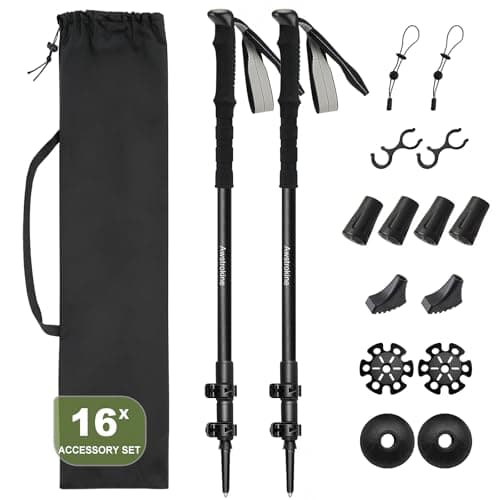
It was a soggy Saturday on the Larch Mountain trail, the kind of morning where Portland drizzle turns the first two miles of switchbacks into a slow-motion mud luge. My old aluminum poles were doing their usual thing: rattling loose at the flip-locks, adding a tiny but annoying wobble to every plant. I'd been meaning to try a carbon pair for months, and when these Awstrokine carbon fiber trekking poles landed on my doorstep, I figured the PNW was exactly the right place to find out whether the "all-weather" claims held up.
We may earn from qualifying purchases.
What I noticed first
The weight. I picked up one pole and my brain did a quick double-take. At 6.07 oz per pole, the pair together barely registers. I've got a water filter that weighs more than one of these sticks, and that kind of math never gets old when you're obsessing over a base weight spreadsheet at 11 p.m.
The 3K carbon fiber shaft feels solid, not hollow-fragile the way some ultralight poles have tricked me before. There's a rigidity to the 16mm shaft that inspires confidence on rocky scrambles where I'm actually leaning into the pole, not just tapping it along for rhythm. I also appreciated that the full-length EVA foam grip extends well below the main grip body, so on steep descents I can choke down without abandoning the foam entirely. That's a small detail, but it matters on anything with real elevation change.
Out of the box you get a legitimately complete kit: tungsten carbide tips, mud baskets, snow baskets, boot baskets, rubber boots, quick-attach clips, elastic cords, and a carrying bag. I didn't have to order a single extra accessory, which, honestly, doesn't always happen at this price point.
Who should skip it
If you're planning to use these as a tent pitch solution for an ultralight shelter, I'd want to know more about their load-bearing ceiling before I committed to that. The listing doesn't publish a static load rating, and I didn't stress-test them that way. Carbon fiber can fail differently than aluminum, a crack rather than a bend, so if you're deep in the backcountry and something breaks, you don't get a bent-but-functional pole. You get two pieces. That's not a dealbreaker, but it's a real consideration for solo trips far from the trailhead.
I'd also pump the brakes if you're someone who tends to death-grip their poles on technical terrain and puts serious lateral torque through the shaft. These are built for trail hiking and backpacking, not technical mountaineering. The flip-lock mechanism feels secure, but I noticed it needs a firm, deliberate close to seat properly. The first time I snapped it shut in a hurry, I had about an inch of unexpected give mid-hike. That's my one real complaint: the lock requires more conscious engagement than I expected, and on a cold, wet morning with gloves on, "deliberate" is harder than it sounds.
Kids who are still in the phase of treating gear like a weapon probably shouldn't be the primary user of carbon poles at any price. And if the budget is genuinely tight and you need something you can accidentally spike into a rock face without guilt, a mid-range aluminum set might serve you better.
What I actually liked
The EVA grips deserve their own moment. I've used cork, I've used rubber, and in sustained PNW rain, foam EVA is just the right call. It doesn't get slick, it doesn't absorb cold the way rubber does, and after a five-hour day my palms weren't screaming. The wrist straps are padded and the buckle is easy to adjust one-handed, which matters when you're stopping to layer up on a windy ridge and don't want to fuss.
The adjustment range, 26 to 51 inches, covers a genuinely wide spread of heights and terrain configurations. I shortened them for a long climb up a steep grade, lengthened them for the descent, and the transitions took maybe ten seconds each. After the first outing I'd say the sweet spot for locking is a deliberate two-finger press until you hear the click. Once I got that habit down, they stayed put for the rest of the day without a single sag.
Pack size is another real win. Collapsed to 26 inches, they strap neatly to the side of my 40L pack. Disassembled to 21 inches, they fit inside if I need the external loops free. For travel days or when I'm throwing the pack in a car, that matters. I've had full-length poles turn into an entire logistical ordeal at a trailhead parking lot. These don't do that.
If you're a senior hiker, a returning hiker after injury (I've been there), or anyone who's ever finished a long day and felt the weight of their poles in their forearms, the 6-ounce-per-pole number is worth taking seriously. Check current availability on Amazon and see if they fit your setup.
| Pros | Cons |
|---|---|
| Genuinely ultralight at 6.07 oz per pole | Flip-lock needs deliberate, firm closure, tricky with gloves |
| Full EVA grip with extended lower section | No published static load rating for tent-pitch use |
| Complete accessory kit included out of the box | Carbon failure mode (crack vs. bend) is less forgiving in remote terrain |
| Wide 26"–51" adjustment range | Price not currently listed, harder to compare value directly |
| Packs to 21" disassembled for travel | Limited color/style options (based on listing) |
For the day-hiker who's done the aluminum shuffle and wants to feel the difference that a lighter pole actually makes on a full-day outing, these are a compelling option. The PNW rain test was a pass. Grab them on Amazon and give your arms a break on the next climb.
Gear that disappears into the background is the best gear. On Larch Mountain that soggy Saturday, these poles mostly did exactly that., Dave