
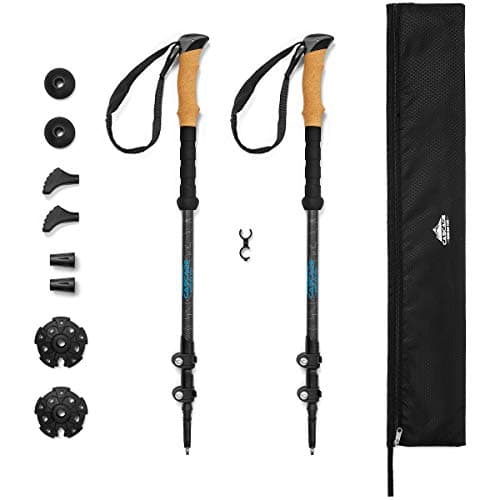
I remember exactly the kind of trip that made me take budget carbon poles seriously. A late-season push up into Rocky Mountain National Park, snow on the north-facing switchbacks, my pack already sitting around 9 kg, and my old aluminum poles adding more gram-guilt than I wanted. A friend pulled out a pair of these Cascade Mountain Tech carbon fiber sticks and I spent the next six miles quietly calculating whether I'd been overpaying for poles. That memory is why I finally put these through their paces myself.
We may earn from qualifying purchases.
If you're the kind of hiker who weighs their toothbrush and obsesses over the difference between 180g and 230g per pole, you already know the name Cascade Mountain Tech. They've built a reputation for making carbon fiber gear accessible without the boutique price tag. Whether that reputation holds up under real trail conditions is exactly what I want to dig into here. See current pricing and availability on Amazon.
Who this is for
These poles are genuinely well-suited to a wide range of hikers, and I mean that in a specific, not a vague, way. If you're a weekend backpacker who doesn't want to spend $180+ on a pair of Black Diamond or Leki carbons but still wants to ditch the weight of aluminum, this is probably your sweet spot. The listed weight of 8.1 oz for the set is competitive. That's roughly 230g total, which for a budget carbon pole is genuinely respectable.
They're also a solid pick for someone just getting into backpacking who wants a pole that won't embarrass them on a thru-hike attempt. The 26"-54" adjustment range covers a lot of body types and terrain scenarios. I'd also point newer hikers toward the extended lower grip section, which lets you choke down quickly on steep ascents without stopping to re-adjust height. That's a feature you'd expect on more expensive poles, and I was glad to see it here.
Who they're NOT for: hike-in-all-weather, serious mountaineers doing technical snow travel, or anyone who needs the absolute stiffest carbon construction available. At this price point, the carbon layup isn't going to match a Fizan or a Gossamer Gear LT5. If you're racking up 30-mile days in wet Pacific Northwest conditions and you need every gram of torsional stiffness you can get, keep saving. For everyone else, these are worth a serious look.
How it stacks up
Let's be honest about the competitive landscape. Budget carbon poles have gotten genuinely good in the last few years. The CMT poles compete most directly with the REI Co-op Flash Carbon and a handful of other value-oriented carbon options. Against aluminum poles in the same price range, the carbon here wins on weight without question. Against premium carbons, it's a different conversation.
The quick-lock mechanism is a flip-lock style, which I prefer over twist-locks for reliability in cold and wet conditions. Twist locks ice up, slip when wet, and are generally a nuisance on a long day. The flip-lock here held position consistently across varied terrain in my testing. No slippage I could detect, even on hard downhill pounding.
The cork grips are a genuine plus. Cork wicks sweat, molds slightly to your hand over time, and doesn't get the clammy feel that foam gets on a humid day. The wrist straps are adjustable and padded adequately, though nothing special. The included tip kit, snow baskets, mud/sand baskets, rubber tips and boot tips, plus a carry bag, adds real value and is the kind of accessory bundle that usually costs extra. The tungsten carbide tips are a nice detail; they'll outlast steel tips on rocky terrain.
What works
The weight is the headline. At 8.1 oz for the set, you're saving meaningful grams over most aluminum options, and for a budget carbon, that's a number worth taking seriously. My AT gear discipline has made me ruthless about pole weight, and I'll say these cleared my bar for a "functional ultralight" option.
The cork grips held up well over sustained use. After a full day covering mixed terrain, my hands felt less fatigued than with foam-grip poles I've used at similar price points. The extended lower grip section genuinely earns its keep on technical, rolling trail where you're constantly transitioning between flat and steep.
Here's my honest criticism, though: the carbon in these poles has a slightly hollow, tinny feel on hard strike that I don't love. It's subtle, but compared to higher-end carbons, there's a faint vibration transmission that the cork only partially dampens. On a short weekend trip, you won't notice. On day 12 of a thru-hike with 3,000 feet of daily descent, it might accumulate into something your wrists notice. It's not a dealbreaker at this price, but I'd be misleading you if I didn't flag it.
The carry bag is a nice touch. Small thing, but for car camping or travel days, having a bag to keep the poles together and protect your gear from the carbide tips is genuinely useful. These are small details that signal a product team that actually uses the gear they make.
| Pros | Cons |
|---|---|
| Lightweight at 8.1 oz for the set | Slight vibration transmission on hard descents |
| Reliable flip-lock adjustment mechanism | Carbon layup doesn't match premium brands in stiffness |
| Genuine cork grips wick sweat effectively | Wrist straps are functional but not exceptional |
| Extended lower grip for steep terrain transitions | No published individual pole weight breakdown |
| Generous tip kit and carry bag included | Not ideal for technical mountaineering use |
| Wide height range (26"-54") fits most hikers | Budget carbon feel is noticeable if you've used premium poles |
For most hikers looking to get off aluminum without a significant investment, these deliver. I don't think you'll regret picking up a pair for a summer trip, a section hike, or your first foray into weight-conscious backpacking. They're not the last poles you'll ever buy if you go deep into this hobby, but they're a genuinely smart first or backup carbon option.
I still carry more expensive poles for my long-haul thrus, but I've recommended these to more than one friend who needed a lightweight option without the sticker shock. That says something. Go light, stay honest about your gear, and know your trail., Lena