
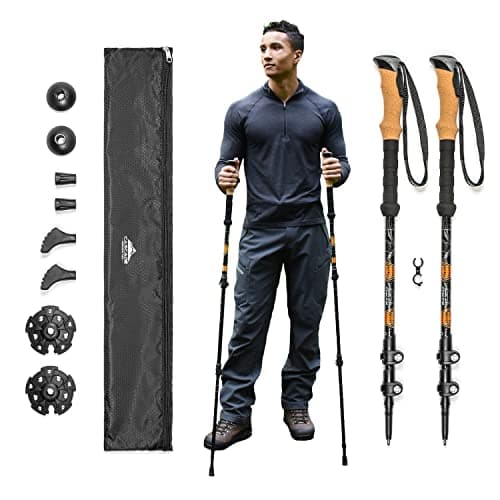
It was a soggy Saturday on the Timberline Trail, somewhere between the Ramona Falls junction and a very muddy river crossing I hadn't quite planned for. My old poles, a pair I'd nursed through two seasons, chose that exact moment to give up the ghost. The locking mechanism on one just... let go, and I spent the rest of the day essentially using a ski pole with an identity crisis. That trip convinced me I needed something reliable, affordable, and trail-ready before the next wet-season outing. That's how I ended up testing the Cascade Mountain Tech Trekking Poles over several months on PNW trails.
We may earn from qualifying purchases.
What I noticed first
Right out of the bag, these poles feel purposeful. The cork grips have that slightly rough, natural texture that I've always preferred over bare foam, they don't turn into a slip-and-slide when your palms sweat on a long climb. The extended EVA section below the cork is a nice touch too. On steep switchbacks where you're choking up on the pole for better use, having that extra grippy material lower on the shaft actually makes a real difference. I didn't expect to use it as much as I did.
Each pole weighs in at 10 ounces, which isn't ultralight by any stretch. If you're deep in the ounce-counting world of ultralight backpacking, you've probably already moved on. But for the rest of us, day hikers, weekend backpackers, folks who want solid gear without a carbon fiber price tag, that weight is completely reasonable.
The quick-lock mechanism adjusts from 26 inches up to 54 inches, and it's genuinely easy to use. I've fiddled with twist-lock systems that require two hands, a prayer, and decent upper-body strength. These snapped to my preferred length fast, even with gloves on, which matters when you're trying to adjust mid-trail in the rain.
How it stacks up
The 6061 aircraft-grade aluminum construction is the backbone of what makes these poles punch above their price class. Aluminum at this grade is tough, it absorbs lateral flex without permanently bending, and I've knocked these against rocks more times than I'd like to admit. No dents, no warping, no drama.
The accessory kit that comes with these is genuinely useful. Tungsten carbide tips for hard terrain, rubber baskets for snow and mud, rubber boots for everyday trail use, and tip covers for transport. I appreciated not having to separately source winter baskets before a late-season hike up toward Mount Hood. Most poles at this price point give you a single tip option and call it done. Cascade Mountain Tech actually thought through the accessory situation.
Compared to other budget aluminum poles I've used, the wrist straps here are comfortable enough for a full day. They're padded lightly, adjustable, and haven't caused any hotspots on longer outings. They're not the padded, anatomically shaped straps you'd find on a $150+ pole, but they do their job. If you're doing a multi-day trip and logging 15-mile days, you might want to swap in aftermarket straps. For day hikes and moderate backpacking, they're fine.
I've also compared these side-by-side with a friend's carbon fiber poles that cost three times as much. The difference in vibration absorption on rocky terrain is noticeable, the cork grip helps, but aluminum just doesn't dampen as smoothly as carbon. That said, the aluminum here is more forgiving if you accidentally use a pole to catch a fall on a boulder field, which I have done, twice, on the same trail, don't ask. Carbon would've cracked. These didn't. Check current pricing here, they've historically been one of the better deals in this category.
Where it falls short
Okay, here's my honest gripe: the locking mechanism, while quick to adjust, doesn't inspire full confidence under heavy lateral load. If you're leaning hard on these during a steep, wet descent, the kind where you're basically rappelling down a root-covered hillside, the locks can feel slightly less solid than I'd want. I haven't had one slip on me, but there's a subtle give that makes me wish the tolerances were tighter. I'd recommend checking and re-tightening the locks before any serious descent.
The travel bag included is also a bit flimsy. It does the job of bundling the poles for transport, but the stitching started fraying on mine after a handful of uses. It's not something that affects performance on the trail, but it's a small signal about where cost-cutting happened.
And honestly, the tip covers, the rubber caps you use to protect the carbide tips in transit, are annoyingly easy to lose. They're small and don't grip the tips particularly well. I've already misplaced one. If you're someone who loses tiny gear accessories (hi, it me), just throw an extra rubber band around them or tuck them somewhere safe immediately.
None of these issues are dealbreakers for the price point. But they're real, and I'd rather tell you upfront than have you find out mid-trip. If you're looking for a budget-friendly, durable set of trekking poles for PNW conditions or beyond, these Cascade Mountain Tech poles are worth your consideration.
I've been harder on gear that cost twice as much and delivered less. These poles won't win any ultralight awards, and the lock mechanism could be stiffer, but they've held up through a wet PNW hiking season without any real complaints from me. If you're newer to trekking poles or want a reliable backup set that won't wreck your budget, I'd genuinely point you toward these. Stay dry out there., Dave