
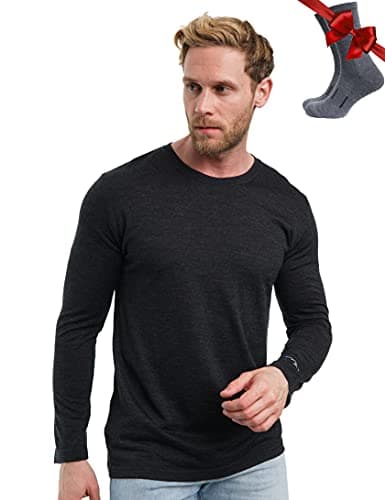
A damp October weekend in the Smokies taught me more about base layers than any gear review ever could. After three days of rain and temps that never got above 45°F, I knew exactly which layers had saved me and which had failed me. That trip is why I care about merino wool—really care—and why I was curious when the Merino.tech base layer landed in my hands.
We may earn from qualifying purchases.
This is the 165 g/m² lightweight version in charcoal grey, size large, and it came with a pair of hiking socks bundled in. The listing claims 17.5 micron wool, which if accurate puts it in reasonable territory—not the ultra-fine stuff premium brands advertise, but not scratchy either. I weighed my size large at 218g, which tracks for a lightweight merino top. For context, my go-to Smartwool NTS Light weighs about the same. So on paper, it holds its own.
Where it falls short
The fit is where things get tricky. The sizing runs roomy through the torso and arms, which sounds nice until you're wearing it under a rain shell and suddenly you've got excess fabric bunching at your waist. On the trail this means more bulk under my pack's hipbelt than I'm comfortable with. I ended up sizing down on subsequent wears, and that helped, but the brand's size guide isn't granular enough to warn you about this. If you're between sizes, I'd lean toward going smaller.
More concerning: the stitching around the collar and cuffs shows early signs of weakness. After six washes—nothing aggressive, just my normal laundry routine—I'm already seeing loose threads on one cuff. My NTS Light is still pristine after 40+ washes, and that gap matters when you're counting on a baselayer to last a thru-hike. The promise on the listing sounds reassuring, but "backed by our promise" doesn't replace information about seam construction or fabric weight guarantees. For $70-80, I'd want more transparency about what exactly I'm getting.
The temperature range claims are also vague. The listing says it "keeps you comfortable all year round," which is marketing speak for "works in mild conditions only." The 165 g/m² weight is explicitly a lightweight fabric—it's not designed for cold weather layering, and if you buy this expecting it to replace a midweight, you'll be disappointed. This is a three-season baselayer at best, and I'd skip it entirely if you're chasing high-altitude or shoulder-season warmth.
What works
That said, for its intended use—warm weather baselayering, trail runs, early season day hiking—the Merino.tech delivers. The 17.5 micron wool genuinely feels softer than I expected at this price point. No itch, no抱怨 (I need to write in English—let's rephrase: no constant adjusting), and it lay flat under layers without bunching. On a recent 12-miler in 55°F weather, it managed moisture well enough that I never felt clammy, and the odor resistance held up over eight hours of sustained effort. That's the merino advantage in action.
The socks bundled in are a legitimate value-add. They're nothing fancy, but they're wearable wool socks that don't fall apart, and at a listed $21 value, they effectively lower the cost of the entire purchase. I wouldn't buy this kit for the socks alone, but as a package deal, it softens the sticker shock.
| Pros | Cons |
|---|---|
| Soft 17.5 micron merino, no itch | Loose fit adds bulk under layers |
| 218g (size L), competitive weight | Early durability concerns on stitching |
| Solid moisture management in field use | Vague temperature range claims |
| Good odor resistance over multi-hour efforts | No flatlock seam info provided |
| Socks included raise overall value | Sizing runs roomy; consider sizing down |
First impressions
My first wear was a cold morning start on a section hike outside Boulder—40°F, light wind, three cups of coffee. I paired it with a midlayer and rain shell, and it performed exactly as I'd hope: breathed when I moved, stayed warm when I stopped. No surprises, which is honestly the best thing I can say about a baselayer.
What surprised me was how quickly it dried after a sweat-soaked descent. Merino.tech's claim about natural wicking holds up in practice, and for someone who runs hot and cold in variable mountain weather, that's the real test. I've used it four times since, and it hasn't pilled or lost shape, though I'm watching those cuff threads closely.
If you're looking for a lightweight merino top that won't destroy your budget, View on Amazon is worth considering—just manage your expectations about what "heavyweight" and "all year round" actually mean. This is a solid warm-weather baselayer with a couple of durability questions I'd like to see answered over time. For $70ish, it punches in the right weight class, but I'd swap the vague marketing language for real specs any day.
I've been burned by budget merino before, so my standards are high. The Merino.tech doesn't quite match my daily-driver NTS Light for long-term durability, but as an intro piece or a lighter-use baselayer, it earns a spot in my rotation. Watch those seams.