
We may earn from qualifying purchases.
A few years back, I took a hard fall on a rocky descent in the Columbia River Gorge. Nothing broken, but my left knee has been payback ever since. Since then, I've treated trekking poles not as a luxury but as a requirement. I go through a lot of them, cheap ones, expensive ones, ones that rattle apart after a season and ones that somehow stay together through a PNS rainy season. So when the TREKOLOGY Trek-Z showed up at my door, I wasn't expecting miracles. I was expecting it to not fall apart before I got to the trailhead.
Compared to what I'd used before
My previous set was a budget aluminum pair I'd grabbed on sale. They did the job, but they were heavy, and the twist-lock mechanism always felt like it was one hard thunk away from slipping. I'd tighten them down, start down a grade, and feel the length slowly creep longer on one pole while the other stayed put. It's an annoying problem when you're trying to maintain rhythm and your poles are fighting you.
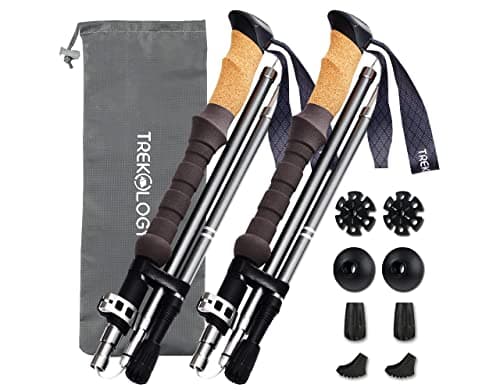
The Trek-Z uses a metal flip lock instead. That's a meaningful difference. Flip locks are generally more reliable under load and way easier to adjust when your hands are cold or wet. On my first outing with these, a damp October weekend on the Lewis and Clark Trail near the coast, I was able to adjust height on the fly without stopping to wrestle with a stuck twist ring. The adjustment range spans from 110cm up to 130cm, which covers a wide spectrum of users. I'm just over six feet, and I've got them set about two clicks from max without any play.
The cork grip was something I was skeptical about going in. I've used foam grips and outright rubber handles that got slick the second they got wet. Cork isn't magic, but it genuinely does a better job of staying grippy when your palms are sweating or you've got trail mist rolling through the trees. I noticed the difference on day two when we had some light rain and my hands never felt like they were sliding off the poles.
I should mention the weight. At 11.5 ounces per pole, these are lighter than my old budget set by a noticeable margin. Not the absolute lightest I've ever carried, carbon fiber options exist that shave off another few ounces, but the price point here means you're not making the trade-off most of the time between weight and cost. You can get a decent pair without selling a kidney.
How it held up
I've put probably 60 miles on these so far across varied terrain. Loose gravel, root-studded singletrack, a couple of stream crossings where I used them for stability in place of a handrail that wasn't there. The tri-fold design has held up without any creaking or loosening in the joints. TREKOLOGY mentions the joints have been enhanced with added metal caps, and honestly I was ready for something to rattle loose, that happened with a previous folding pole set I owned, but it hasn't.
The aluminum construction feels every bit as solid as the description suggests. Aircraft-grade aluminum gets thrown around a lot in product copy, but in this case the poles genuinely feel like they can take a beating. I've had these thunk against rocks, caught the tip on a root and torqued the whole pole sideways, and nothing shifted. The flip lock held firm.
One thing I did notice, and this is the opinionated part, so buckle up, the EVA foam shaft sections above the cork grip are fine functionally, but they can get slick in sustained wet conditions. I'm talking hours in actual rain where the foam absorbs some of that moisture and doesn't dry out as quickly as the cork. On a three-day trip last month, I had a couple moments on steep descents where I wished the foam had a texture pattern instead of being completely smooth. It's not a dealbreaker, and I'm aware this might be more of a personal preference thing than a universal flaw, but it's something worth knowing if you're buying these for wetter climates. Pacific Northwest buyers, I'm looking at you.
Out of the box
Everything you need is in the box. Pair of poles, holder bag, and that's about it, which is all you need, honestly. The bag is nothing fancy but it's lined and it keeps the poles together so they're not rattling around in the top compartment of your pack.
Folding them down to 15 inches took me about thirty seconds the first time. You figure out the sequence, and it becomes muscle memory after a couple uses. They fit into the side pocket of my 45-liter pack without me having to compress anything or rearrange gear. That compact carry size is the real win for anyone doing multi-day backcountry routes where every inch of space counts.
Setup was straightforward. Adjust to your height, flip the lock tight, give it a firm pull to confirm it's seated. Some budget poles I've used feel like you have to really trust the lock mechanism. The Trek-Z's metal flip lock inspires confidence immediately.
I've been asked a few times whether these are good for beginners or more experienced hikers. In my experience, they land solidly in the "solid intermediate to advanced" category. They're well-built enough for regular use, light enough for long days, and compact enough for travel or thru-hiking. If you're just getting started and want something that'll grow with you without breaking the bank, these are worth considering.