
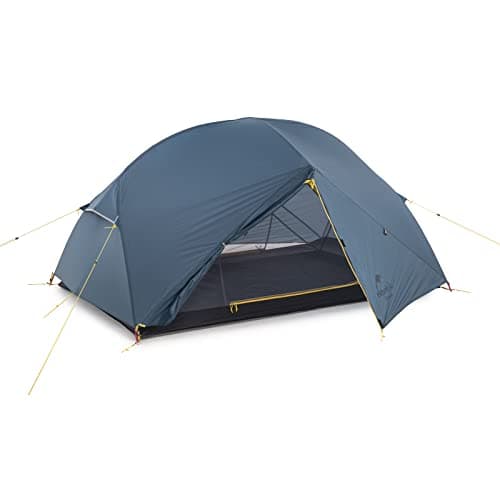
There's a specific kind of dread that hits when you're three miles from camp, the sky turns the color of old pewter, and you're not sure your shelter is going to hold. I felt it on a wet September weekend in Rocky Mountain National Park, rolling into a wind-scoured site above 11,000 feet with a new tent I hadn't fully trusted yet. That tent was the Naturehike Mongar 2P, and by morning I had a much clearer opinion of it than I'd had at the trailhead.
We may earn from qualifying purchases.
I weight-count everything. My base pack weight for the PCT hovered around 4.8 kg, and I'm not the type to throw a "budget" tent in the mix without measuring the actual cost in grams. The Mongar's listed weight is 5.3 lbs for the whole kit including the groundsheet, which converts to roughly 2,404 g. That's not ultralight. It's solidly mid-range, and I want to be straightforward about that before we go any further. If you've got a Big Agnes Copper Spur or an MSR Hubba Hubba as your mental benchmark, this tent lives in a different weight class. That said, it's competing on price, and the conversation changes when you factor that in.
Where it falls short
Let's get the honest part out of the way first, because that's what you're really here for.
The weight is the thing that bothers me most. At around 2,400 g for the full system, you're carrying noticeably more than you would with a comparably-priced Big Agnes option, and considerably more than a Zpacks or similar. For a solo gram-counter doing a thru-hike, this would be a hard sell. Split between two people, it becomes 1,200 g each, which is more palatable, but it's still a number you feel after 15 miles.
My second gripe is the packed diameter. At 19.7 by 5.9 inches, it's not a small cylinder. I had to lash it to the outside of my pack on one trip because it wouldn't seat cleanly inside a 65L bag alongside my other gear. That's annoying. Not a dealbreaker for car camping or short backpacking trips, but on a long route where pack organization matters, it's something to plan around.
I'd also note that the inner tent uses B3 mesh, which is breathable and great for three-season bugs, but it means you're relying heavily on the fly in cold weather. I wouldn't take this tent above treeline in November and feel confident. It's a three-season tent that means it.
Out of the box
The Mongar ships with the tent body, the fly, the 7001 aluminum alloy poles, stakes, and a groundsheet included. That groundsheet detail matters, because a lot of budget tents charge you extra for a footprint. Getting it in the box at this price point is a genuine value-add and saved me from having to cut a Tyvek sheet.
Setup is a Y-frame design, which is refreshingly unfussy. Naturehike actually sews the instructions into the stuff sack, which I thought was a smart move. No fumbling for a paper pamphlet in the rain. The first time I pitched it, I had it up in under ten minutes solo, which for a double-wall freestanding tent is respectable. The poles click together intuitively, and the clips attach to the frame quickly even with cold hands.
The 7001 aluminum alloy poles feel solid. Not as refined as the DAC poles you'd find on premium shelters, but not the flexy fiberglass rods you get on truly budget tents either. They inspire reasonable confidence. You can check out the full setup and specs over at the Amazon listing if you want to see the included hardware before you buy.
Interior dimensions come in at 82.7 x 53.2 x 41.3 inches, which gives you more than 30 square feet of floor space. Two adults fit comfortably with pads and bags. The 41-inch peak height is enough to sit up, change layers, and not feel like you're in a coffin. I've tested tighter two-person shelters from brands that charge twice as much.
What I actually liked
The waterproofing impressed me more than I expected. The fly and floor both spec at 3000mm HH with 210T polyester, and during that rainy Rocky Mountain night, I didn't find a drop of water inside. The seams held. The vestibules, one on each side, kept my boots and pack lid dry without issue. For a tent in this price range, that's not a given.
Those dual vestibules are genuinely useful. I've used plenty of one-vestibule two-person tents where two hikers negotiate awkward gear choreography at the door. Having a vestibule on each side means each person has their own dedicated mud room. Small quality-of-life feature, but after a long day I care about small things.
The dual-door setup pairs nicely with the ventilation options. The vestibule can be staked out fully, partially opened for a cross-breeze, or closed tight. On the September trip I mentioned, I ran both vestibules at a partial crack and woke up with minimal condensation on the inner mesh. That's a win for a double-wall design at this price.
The 3000mm floor waterproofing also gave me confidence pitching on wet granite slabs where I didn't have much choice about site selection. With the included groundsheet underneath, I felt genuinely protected. If you're a weekend car-to-camp backpacker or someone doing their first multi-night trip and don't want to spend $500 on a shelter, the Mongar punches above its price. Check current pricing on Amazon to see where it lands, since I wasn't able to pull a live price for this review.
The build quality on the zippers and pole sleeves also felt more solid than I expected. I've used cheap tents where the zipper starts fraying by the second season. The Mongar's zippers ran smoothly throughout my testing and didn't snag on the mesh. That's one of those things you don't appreciate until a zipper on a bad tent fails at 5 a.m. in a downpour.
| Pros | Cons |
|---|---|
| 3000mm HH on fly and floor | ~2,400 g total weight is mid-range, not ultralight |
| Groundsheet included in the box | Packed size (19.7 x 5.9 in) is bulky for larger packs |
| Dual doors and dual vestibules | Mesh inner means limited cold-weather versatility |
| Fast Y-frame solo setup | No listed pole brand or warranty details |
| Solid 7001 aluminum alloy poles | Price fluctuates; no permanent MSRP anchor |
| 30+ sq ft floor space for two |
The Mongar isn't the tent I'd choose for a thru-hike where every gram compounds over thousands of miles. But for weekend trips, shoulder-season car-camping backpacking, or splitting the load with a partner on a mellower route, it's a solid, honest shelter. If you want to dig into the specs yourself, the full listing is here. Buy it with clear eyes about the weight, and I don't think you'll be disappointed by much else.
I'm Lena, and I've slept in a lot of tents that cost four times this much and were only marginally better. Sometimes the budget option earns its place in the rotation. This one mostly does., Lena