
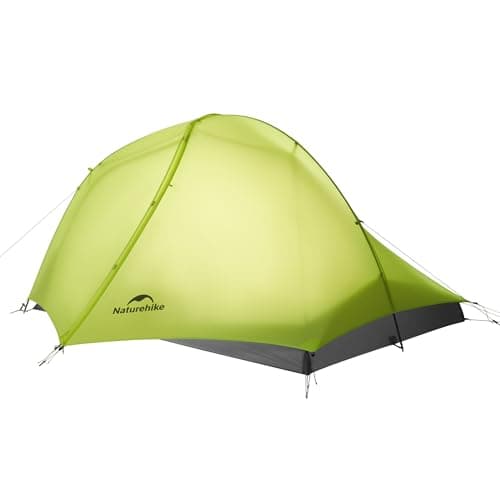
There's a specific kind of dread that sets in when you're three miles from the trailhead, the sky opens up, and you realize your tent is the weakest link in your kit. That happened to me on a soggy fall weekend in the Cascades, my old budget shelter sagged, pooled, and basically became a very expensive puddle collector. I started hunting for something lighter and more trustworthy, and the Naturehike Star Trail landed on my radar. At 2.76 lbs for the two-person version, it's hard to scroll past without at least stopping to look.
We may earn from qualifying purchases.
How it stacks up
Let's talk weight first, because that's usually the conversation starter for backpackers. At 2.76 lbs for a two-person shelter, the Star Trail is competitive without being exotic. You're not going to mistake it for a Zpacks or a Six Moon Designs, but you're also not dropping $400-plus. For a sub-$150 ultralight tent (pricing fluctuates, so check the current Amazon listing), this sits in a genuinely useful middle ground.
The packed size is legitimately impressive. 17.7 by 5.1 inches means it slips into the side pocket of most 40L packs without a fight. I've tested gear that claims "compact" and then mocks you from the top of your pack. This one actually delivers on that promise.
Where I get a little cautious is the waterproofing spec. The outer tent uses 10D nylon with a PU1500mm rating. That's passable for three-season use in light-to-moderate rain. But here in the PNW, "moderate rain" is basically a myth, we get sustained, heavy, sideways rain that exposes every weakness in a canopy. A 1500mm HH outer is on the lower end of what I'd want in those conditions. The floor and footprint jump to PU3000mm, which is solid, and I didn't wake up in a puddle. But if you're camping in truly nasty weather regularly, I'd keep that outer rating in mind. For drier climates or summer shoulder-season trips, it's a non-issue.
Setup is a genuine highlight. The 3-minute pitch claim felt like marketing copy until I actually tried it. The pole structure is straightforward and color-coded. First time out, solo, in fading light, I had it standing in under five minutes. That counts.
Who this is for
Honestly, this tent makes the most sense for three kinds of hikers. First, the weekend backpacker who's done a few trips and is ready to ditch the heavy car-camping shelter they've been borrowing from their dad. Second, the gram-counter on a budget who can't justify (or finance) the ultralight boutique options. Third, the solo hiker who wants the extra space of the two-person version without the weight penalty of a traditional two-person tent.
If you're planning a winter alpine push or expecting prolonged heavy rain, I'd want a higher HH rating on that outer shell. But for three-season trips from spring through early fall, day hikes with overnight extensions, bikepacking overnights, summer ridge camping, this is a capable, honest performer.
The interior dimensions are worth mentioning. 82.7 by 51.2 inches with a 39.3-inch center height means two adults can actually sit up, which is not a given at this weight class. I'm 5'11" and I didn't feel like I was crouching in a coffin. That matters on a rainy morning when you're waiting out a storm and eating oatmeal with nowhere to go.
What I actually liked
The full-coverage mesh inner is my favorite feature. It keeps the airflow moving, which cuts down on condensation, a real problem in a single-wall-adjacent design. I've slept in cheaper tents where the inner drips on you from condensation alone, which is a miserable experience that tricks you into thinking you sprung a leak. The mesh helps prevent that cycle.
The footprint is included, which is a small thing that budget tents often skip and shouldn't. Pairing the PU3000mm floor with the footprint gives you real ground protection without having to buy an accessory separately.
Packing it back up is easier than most. Some ultralight tents make repacking feel like origami in the dark. The Star Trail stuffs back down without a ceremony. I appreciate that more than I expected to.
My one real criticism: the 10D outer fabric feels thin underhand. That's partly why the weight is so low, and rationally I understand the trade-off. But when you're pitching in the dark on a rocky site and you catch a corner on a sharp edge, you're going to hold your breath. I'd be careful with site selection, use the footprint religiously, and consider seam-sealing the outer if you plan heavy use. It's not fragile, but it's not armor either.
| Pros | Cons |
|---|---|
| Genuinely lightweight at 2.76 lbs (2-person) | PU1500mm outer HH is low for heavy rain |
| Packs down to 17.7 × 5.1 inches | 10D outer fabric needs careful site selection |
| Full-mesh inner reduces condensation | No vestibule details confirmed in listing |
| Fast, beginner-friendly setup | Pricing not listed, fluctuates on Amazon |
| Footprint included | Mesh inner alone isn't ideal for cold nights |
| Generous interior height for the weight class |
For the weight, the packability, and the price range, the Naturehike Star Trail punches above its class on a typical three-season trip. It's not my go-to when October rain is supposed to hit 40mm overnight, but for summer ridgelines and dry-shoulder-season adventures, I'd reach for it without hesitation. If it sounds like your kind of shelter, check it out on Amazon and see where the price sits today.
My knee's the reason I started backpacking lighter, and tents like this make that trade-off feel less like sacrifice and more like smart packing. Get out there and stay dry-ish., Dave