
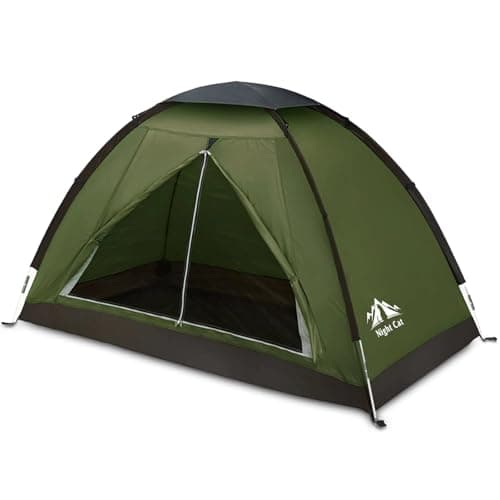
I was planning a solo shakedown trip in the Rockies last fall, somewhere above 9,000 feet where afternoon storms roll in fast and camp setup windows are short. I needed something I could pitch in under two minutes, something that wouldn't soak through by midnight, and something light enough that I wouldn't resent it at mile fifteen. The Night Cat ZP-10 caught my eye because the price was low and the PU 3000mm waterproof rating looked promising on paper. I'll be honest: I didn't expect much. I rarely do with budget tent hype.
We may earn from qualifying purchases.
What I actually liked
The waterproofing is the real headline here. A PU 3000mm rating is legitimate wet-weather protection, and Night Cat backs it up with taped seams on every inseam and stitching line. That's not a given at this price point. I've paid more for tents that let moisture creep through seams by morning, and this one held up through a genuine downpour without a drip inside.
The ventilation design also impressed me more than I expected. A large mesh door and a mesh window on the roof work together to move air even when the single-layer wall is closed tight. Single-layer shelters can turn into a sauna with condensation clinging to everything you own, but the cross-flow here kept things noticeably drier inside than I'd feared. If you're camping in summer heat or shoulder-season humidity, that matters a lot.
Setup really is as fast as advertised. Two fiberglass poles thread into diagonal sleeves, the whole thing pops into shape, and you're done. For a solo hiker scrambling to beat a thunderstorm, that's worth something real. You can check current availability on Amazon if fast pitching is high on your list.
The packed dimensions, 42x12x12 cm, are compact enough to strap to the outside of a frameless pack without throwing off your balance. I appreciate that.
First impressions
Out of the bag, the tent feels light for its stated 2 kg (4.4 lb). I want to be direct though: 2 kg (roughly 2,000 g) is not ultralight by my standards. I count grams obsessively, and my personal shelter system runs well under 1,000 g. For the PCT crowd or anyone already shaving ounces, this tent asks you to make a trade. You're trading weight for price and durability.
The upgraded fiberglass poles come with a protection case, and I noticed immediately why Night Cat bothered. Exposed fiberglass splinters are a real hazard, and the double-layer design on these poles genuinely does protect your hands during assembly. It's a small detail, but I've drawn blood from cheap tent poles before. This fix is thoughtful.
The interior dimensions, 7.0 x 3.8 x 3.6 ft, fit one adult comfortably with room to shove a pack to the foot. I'm 5'7" and had adequate headroom sitting up. A second adult would make it feel cramped, but one adult and a small child works fine, which is exactly what Night Cat says.
On the trail / in use
My biggest criticism is the weight, and I won't soften it. At 2 kg, this tent costs you. That's roughly 1,000 g more than a comparable single-wall bivy or a quality trekking-pole shelter. Over a 20-mile day at altitude, that difference is in your legs. If you're section hiking, car camping with a short walk-in, or introducing a Scout troop to backpacking, the weight trade is easy to accept. If you're training for a thru-hike or chasing a fast finish, keep looking.
The single-layer construction also means condensation management depends entirely on that ventilation system. In cold, still air below freezing, I'd expect moisture to accumulate on the inner wall faster than a double-wall tent would allow. I haven't tested it in true winter conditions, and I wouldn't recommend it there without more data.
That said, for three-season use in moderate to heavy rain, it performs. The taped seams held. The floor stayed dry. The mesh kept bugs out on a humid evening near a creek. For a budget shelter aimed at casual weekend hikers, families, and anyone just getting into backpacking, it delivers what it promises. See it on Amazon if that profile fits your next trip.
I'd also say the poles, while cleverly protected, are still fiberglass. They'll flex more than aluminum in high wind and they're more prone to snapping under stress. In my experience, fiberglass is fine for calm-weather car camping and short backpacking trips, but I'd be cautious in exposed ridgeline camp spots.
| Pros | Cons |
|---|---|
| PU 3000mm waterproofing with taped seams | 2 kg (2,000 g) is heavy for serious backpackers |
| Fast 1-2 minute setup | Fiberglass poles less durable than aluminum in wind |
| Effective mesh ventilation for a single-layer | Single-layer design can accumulate condensation in cold still air |
| Pole protection case prevents splinter injuries | Not suited for true winter or high-wind exposed camps |
| Compact packed size (42x12x12 cm) | Price not listed at time of writing; check Amazon for current cost |
If you're a weekend warrior, a Scout leader, or a parent looking for a budget-friendly shelter to share with a kid on a trail introduction, the Night Cat ZP-10 is a reasonable pick. It's not my personal shelter. But I'd hand it to a beginner without guilt. Grab it on Amazon and decide if the weight trade works for your style of hiking.
I respect budget gear that actually does what it claims. This one mostly does. Just weigh it yourself before you commit it to a long-mileage trip., Lena