
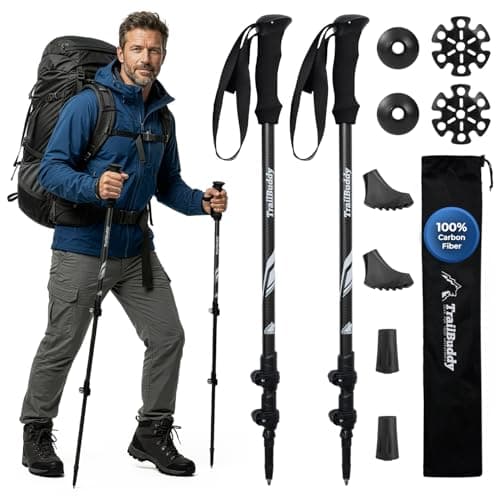
My left knee has a long memory. After I blew it out on a poorly-chosen scramble in the Columbia River Gorge a few years back, I became the kind of hiker who treats trekking poles less like optional accessories and more like load-bearing walls. So when a wet, root-tangled trail on the Olympic Peninsula had me reaching for a backup pair after my usual poles went home in a friend's car, I grabbed the TrailBuddy 3K Carbon Fiber Hiking Poles on short notice. What followed was a pretty honest field test, conducted in exactly the kind of sideways Pacific Northwest rain that breaks lesser gear fast.
We may earn from qualifying purchases.
What didn't click
Let me get the gripe out of the way early, because it's a real one. The flip-lock levers feel a little plasticky. Not fragile exactly, but not confidence-inspiring either, especially when you're cranking them down in gloves on a cold morning. I've used aluminum-shafted poles with chunkier, more tactile locks, and the TrailBuddy's mechanism feels lighter-duty by comparison. It held through my testing, no slippage, no collapse mid-stride. But if you're the kind of hiker who torques everything to maximum and expects marine-grade hardware, you might notice the same thing I did.
Also, the collapsed lengths, 21 inches or 24.5 inches depending on configuration, are good but not ultracompact. They'll fit lashed to the outside of a 40-liter pack without drama, though they're a little long to bury inside one. Minor point, but worth knowing before you buy.
What works
The carbon fiber shafts are the real story here. At 7.7 oz per pole, these are genuinely light. Not "light for the price" light, just light. Over a long day with elevation gain, that difference in arm swing accumulates, and my shoulders noticed it in a good way. Coming off a six-mile descent with a 30-pound pack, I wasn't fighting the poles, I was just using them.
The EVA foam grips deserve a mention too. Foam isn't as fashionable as cork, but on a drizzly PNW morning, foam doesn't turn into a cold, slippery mess the way cork can. My hands stayed reasonably warm and dry, and I didn't develop any hot spots even after a few hours of continuous planting on a muddy trail. The padded wrist straps are better than I expected at this price point, padded enough to actually help on steep climbs without cutting circulation.
The all-terrain tip and basket system is straightforward and practical. I swapped between the standard trail tips and the wider mud baskets in about thirty seconds without tools. For anyone who hikes in multiple conditions, that versatility genuinely matters. The adjustment range, 24 to 54 inches, covers a wide spread of heights and terrain angles, and the flip locks did their job every time I actually needed them, holding position on both flat trail and aggressive switchbacks.
If you've been looking for a solid entry into carbon fiber poles without a carbon fiber price tag, these TrailBuddy poles are worth a serious look. The shaft construction feels noticeably more premium than budget aluminum options I've carried, and the overall package, grips, straps, tips, baskets, warranty, covers the basics well.
Who this is for
Honestly, I think these poles hit their sweet spot with three kinds of hikers. First, the newer backpacker who wants a real upgrade from cheap aluminum without dropping serious money on a boutique brand. Second, the day-hiker with bad knees or dodgy ankles who needs reliable downhill support and doesn't want to overthink the purchase. Third, the traveler who packs poles in checked luggage and needs something that collapses small enough to behave.
They're not the poles I'd recommend to someone doing technical mountaineering or carrying 50-pound loads regularly, where I'd want heavier-duty locking hardware. But for trail hiking, moderate backpacking, and all the soggy, rooty, variable-terrain stuff I throw at gear in western Oregon and Washington? They perform well above what I'd expect at this price.
If you're on the fence, the warranty and US-based customer support reduce the risk considerably. That's not nothing when you're buying outdoor gear online. Check current pricing and availability for the TrailBuddy 3K Carbon Poles on Amazon and see if they fit your budget, because that part I genuinely can't tell you right now.
| Pros | Cons |
|---|---|
| Lightweight carbon fiber shafts at 7.7 oz per pole | Flip-lock levers feel plasticky, especially in gloves |
| EVA foam grips stay grippy in wet conditions | Collapsed length (21–24.5") is tight for packing inside a smaller bag |
| Interchangeable tips and baskets for multiple terrain types | No cork grip option if that's your preference |
| Wide height range (24–54") suits most body types | Hardware feel doesn't match higher-end competitors |
| Includes warranty and US-based customer support | Price not listed at time of review, so budget comparison is tricky |
My knee and I have put a lot of gear through its paces over the last few years, and the TrailBuddy 3K poles earned their spot in my rotation, not as a workhorse replacement for my go-to set, but as a reliable, packable backup that I'd genuinely trust on a solo overnight. If you're newer to poles or just want a carbon option that won't break the bank, I don't think you'll regret them., Dave