
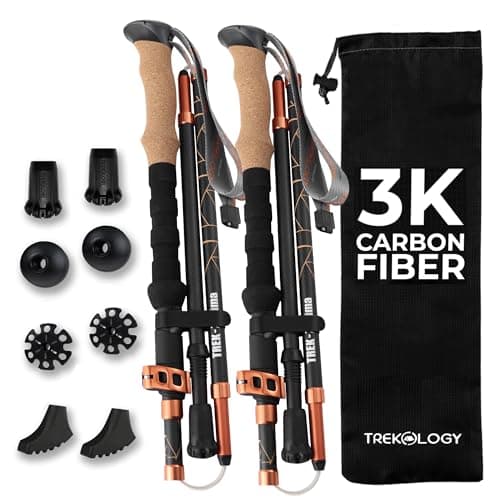
My left knee has strong opinions about descents. Ever since a bad landing on a root-strewn trail outside Ashford, Washington, trekking poles have gone from "nice to have" to "absolutely non-negotiable." So when a muddy weekend on the Wonderland Trail left my old aluminum poles rattling like a tin can full of gravel, I started shopping hard for something lighter and quieter. That's how I ended up testing the Trekology Trek-Z Prima 3K Carbon Fiber Trekking Poles over several damp, Pacific Northwest outings. Spoiler: my knee is pleased.
We may earn from qualifying purchases.
What I actually liked
The weight is the first thing you notice. Each pole comes in at around 220g, which the listing cheerfully describes as "lighter than a smartphone." That's actually accurate, and it matters more than you'd think over a long day. I've swung heavier aluminum poles for miles and felt it in my shoulders by afternoon. With these, that fatigue just... doesn't show up as early.
The 3K carbon shaft does something aluminum can't quite replicate: it damps vibration instead of transmitting it straight into your wrists. On rocky stretches where my old poles were buzzing like a tuning fork, these absorbed the chatter quietly. The "no-rattle" claim isn't marketing fluff. I genuinely couldn't get these to rattle when locked in, even when I was being deliberately rough with them on boulder fields near the Skyline Trail.
Pack-down size is a legitimate selling point for trip logistics. Folded to roughly 15 inches, they fit diagonally inside my pack lid when I needed both hands free for a scramble. That kind of packability matters when you're stuffing a carry-on for a fly-in trip or just don't want poles dangling off your bag on a crowded trailhead shuttle.
The cork grips are the right call for wet conditions. I hike in the PNW, which means my hands are damp more often than not. Cork wicks that moisture rather than turning slick, and after a few outings the grip has started to conform slightly to my hand's shape. The extended EVA foam below the grip is also genuinely useful for choked-up pole technique on steeper sections.
On the trail / in use
Setup really is fast. The metal flip-lock system clicks into place with a satisfying snap, and I've been able to do it one-handed with a rain mitt on. That's the kind of real-world detail that separates poles designed by people who actually hike from ones designed in a conference room.
Adjustability runs from 115 to 135 cm in this size variant (there's also a shorter range option), which covers most adult heights with room to tweak for uphill versus downhill technique. I'm 5'10" and found my sweet spot quickly. The adjustment holds firm. I didn't experience any slippage under load on sustained descents, which is where cheaper twist-lock systems tend to give up on you.
The included accessory kit covers four seasons: mud baskets, snow baskets, and replacement tips. That's a complete kit for most hikers, and it's nice not to have to buy baskets separately. Honestly, the tip replacement alone saves you a trip to the gear shop after a season of abrasive PNW gravel.
Now, my one real criticism: the wrist straps are just okay. They're functional, padded, and adjustable, but they feel like the part of the budget that got trimmed. On a long descent where I was leaning into the poles, the straps felt a bit stiff and didn't drape as naturally as the padded straps on poles costing twice as much. It's not a dealbreaker, but if you're strap-dependent (and with a bad knee, I am), plan on either breaking them in aggressively or swapping them out. That's the honest version.
Carbon fiber also carries a known trade-off: it doesn't bend before it breaks the way aluminum does. On technical off-trail terrain with lots of lateral stress on the poles, keep that in mind. For trail hiking and backpacking on maintained routes, it's a non-issue. For canyon scrambling or anything that puts the poles under sideways torque, I'd think twice.
Who should skip it
If you're primarily doing off-trail scrambles or bushwhacking through tight brush where your poles take a lot of abuse, the carbon construction is a liability. Carbon doesn't survive a rock-wedge snap the way aluminum does, and a broken pole in the backcountry is a much bigger problem than a bent one.
Budget-conscious hikers who stick to day hikes on well-maintained trails might also find that a good aluminum pole serves them just as well at a lower price. The weight savings from carbon are most meaningful when you're carrying everything for multiple days. If your pack weighs 8 lbs. and you're out for four hours, you might not feel the difference enough to justify the premium.
Shorter hikers should double-check the size variant before ordering. The 115-135 cm range is designed for roughly 5'5" to 6'5". There's a shorter version available for folks below that range, so make sure you're ordering the right one.
That said, for a weight-conscious trail hiker or backpacker doing mostly maintained routes in wet or variable conditions, these poles punch well above their price point. I've brought them out on rainy ridge walks, muddy forest trails, and one genuinely miserable socked-in weekend on the Oregon Coast, and they've held up without complaint. If you're ready to make the jump, check the Trek-Z Prima 3K on Amazon to see current availability and sizing options.
| Pros | Cons |
|---|---|
| Very light at ~220g per pole | Wrist straps feel budget-grade |
| 3K carbon damps vibration well | Carbon can snap (not bend) under lateral stress |
| Packs to ~15" for easy carry | Price not always publicly listed; check current Amazon page |
| Cork grips handle moisture naturally | Not ideal for aggressive off-trail scrambling |
| Flip-lock works with gloves on | Size variants can be confusing; double-check before ordering |
| Full 4-season accessory kit included |
My knee has put a lot of miles on these poles since I started testing them, and I haven't regretted the switch from aluminum. They're not a magic fix for every terrain type, but for the trail hiker or multi-day backpacker who wants to shave real weight without sacrificing stability, they're a solid, honest choice. Grab a look at the Trek-Z Prima 3K on Amazon if your current poles are making you miserable on descents. Your knees might thank you too., Dave