

Coastal Vegetation in Acadia National Park: A Complete Guide to Maine's Unique Maritime Flora
The rugged coastline of Acadia National Park hosts one of the most diverse collections of coastal vegetation on the eastern seaboard. From salt-resistant grasses to specialized alpine plants clinging to granite headlands, this unique ecological zone represents a critical transition between land and sea. As someone who has explored these shores across all four seasons, I'm excited to guide you through the remarkable plant communities that make Acadia's coastal ecosystems so special. Whether you're a casual visitor or serious botanist, this comprehensive guide will help you identify, understand, and appreciate the resilient flora that thrives in this challenging maritime environment.
Introduction to Acadia's Coastal Ecosystems
Situated where the North Atlantic meets the Maine coastline, Acadia National Park represents a remarkable ecological intersection. The park's 64 miles of rugged shoreline creates a diversity of microhabitats that support an astonishing variety of plant life. What makes these coastal plant communities particularly special is their adaptation to harsh environmental conditions: salt spray, strong winds, thin soils, and dramatic temperature fluctuations.
Acadia's position at the boundary between two major forest zones—eastern deciduous and northern boreal—contributes to its exceptional coastal vegetation diversity. This transition zone allows plants from both southern and northern latitudes to coexist, creating unique assemblages found nowhere else along the Atlantic coast. As park botanist Dr. Glen Mittelhauser notes in his comprehensive guide "The Plants of Acadia National Park," over 1,100 plant species have been documented within park boundaries, with many rare and specialized species concentrated along the coast.
The geological foundation of Acadia's coastline also plays a critical role in shaping plant communities. The park's iconic pink granite provides limited soil formation opportunities, creating specialized niches where only the most adaptable plants can survive. From the salt marshes of Bass Harbor to the exposed headlands of Schoodic Peninsula, each coastal section offers a different glimpse into how plants have evolved strategies to thrive in challenging maritime conditions.
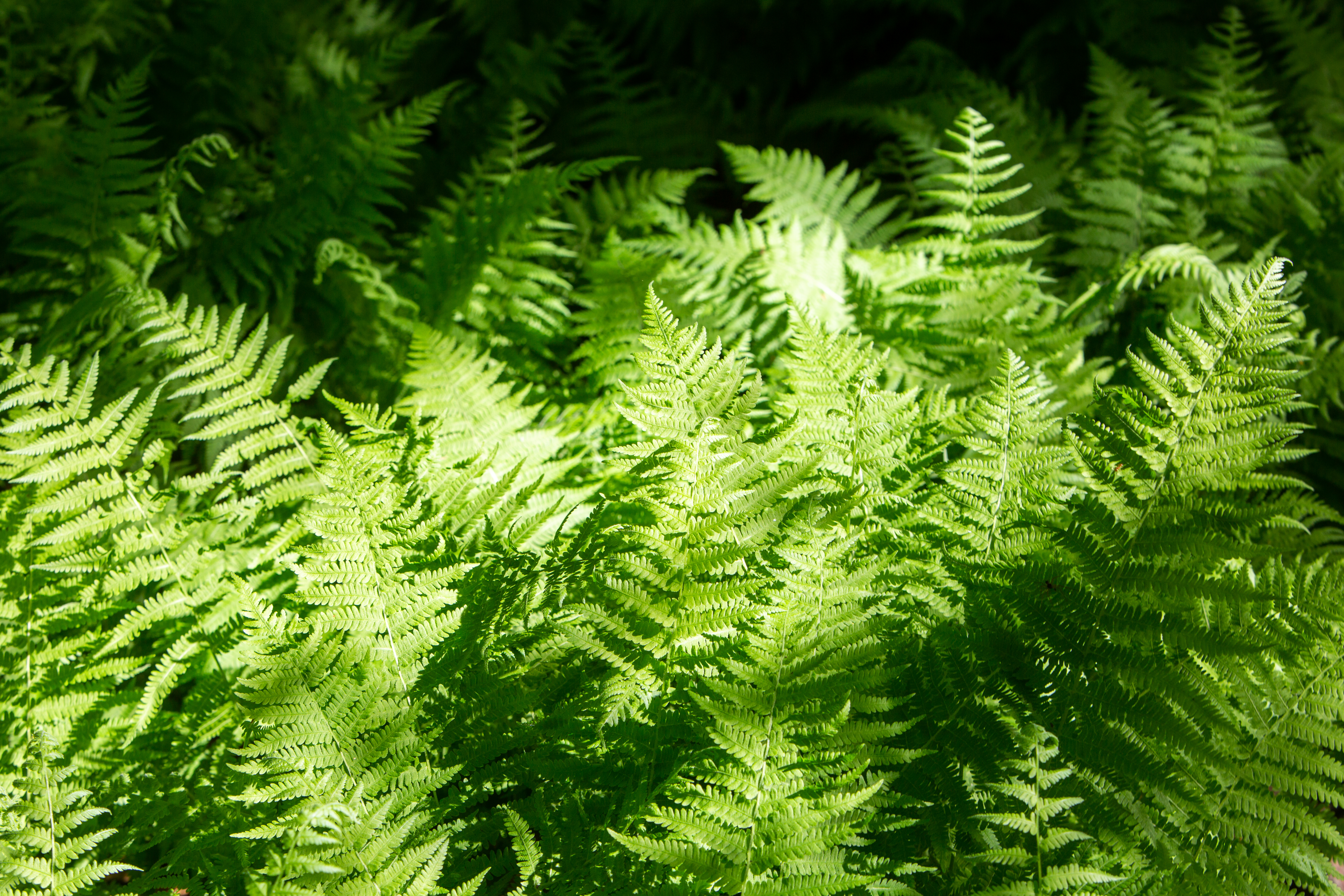
Native ferns thriving in the moist coastal environment of Acadia National Park. Photo by Emma Forthofer, Friends of Acadia, NPS.
As climate change increasingly impacts coastal environments, understanding Acadia's maritime plant communities has never been more important. These plants not only provide essential habitat for wildlife but also serve as indicators of broader environmental changes. The specialized adaptations that allow coastal vegetation to survive in Acadia provide valuable insights into how ecosystems respond to stress and change—knowledge that becomes increasingly valuable as we navigate an uncertain climate future.
Coastal Vegetation Zones in Acadia
Acadia's coastline can be divided into distinct vegetation zones, each characterized by specific plant communities adapted to particular environmental conditions. Understanding these zones helps visitors appreciate the remarkable ecological transitions that occur within short distances along the shore.
The Splash Zone and Intertidal Area
The lowest coastal zone is defined by daily tidal inundation. Here, various marine algae and seaweeds dominate, creating the foundation of the coastal food web. Rockweed (Fucus spp.) is particularly abundant, covering the rocky intertidal areas with its distinctive olive-brown fronds. According to the Schoodic Institute's Coastal Vegetation Spectral Library project, these marine plants "serve as nurseries, feeding areas, and refuge for many other species" while also playing a crucial role in carbon sequestration.
Just above the highest tide line in the splash zone, specialized plants begin to appear. Salt-tolerant species like Seaside Plantain (Plantago maritima) and Sea Lavender (Limonium carolinianum) have developed remarkable adaptations to withstand salt spray and occasional inundation. These plants typically have waxy or leathery leaves to reduce water loss and specialized cells that can excrete excess salt.
Coastal Headlands and Rock Outcrops
The exposed granite headlands of Acadia represent one of the most challenging environments for plant growth, yet they support some of the park's most fascinating plant communities. Here, plants must contend with thin soils, intense winds, salt spray, and extreme temperature fluctuations. Species like Roseroot Sedum (Rhodiola rosea) and Beach-head Iris (Iris setosa) are uncommon coastal headland plants found in Acadia, representing species typically associated with more northern latitudes.
The Maine Natural Areas Program identifies these areas as "Open Headland" communities, noting that "downeast of Acadia National Park, species of the Canadian Maritimes may be present, such as roseroot, beachhead iris, marsh-felwort, and glabrous knotted pearlwort." This highlights Acadia's role as an important biogeographical transition zone where northern and southern species overlap.
Dunes and Sandy Beaches
Though less common in Acadia than rocky shores, the park's limited dune systems and sandy beaches support distinctive plant communities. At Sand Beach, American Beachgrass (Ammophila breviligulata) plays a critical role in stabilizing dunes with its extensive root systems. Beach Pea (Lathyrus japonicus), with its lovely purple flowers and scrambling growth habit, is another characteristic species of these areas.
According to the Wild Gardens of Acadia brochure, "The BEACHES of Acadia National Park vary: no two are quite alike. They range from granite-and-shell sand to large cobbles tumbled by crashing waves. However, the plants growing on the upper reaches of any beach are deeply rooted and all are subject to salt, wind, and occasional inundation."
Salt Marshes and Coastal Wetlands
Acadia's protected coves and inlets often feature salt marshes, where freshwater and saltwater mix to create unique transitional habitats. In these areas, salt-tolerant grasses like Salt Hay (Spartina patens) and Smooth Cordgrass (Spartina alterniflora) dominate. These marshes serve as critical buffers against coastal erosion and provide essential habitat for numerous bird species.
The U.S. Geological Survey's research on salt marsh migration in Acadia indicates that "as salt-marsh plants grow, their roots and rhizomes, along with sediment and organic matter, form peat—the foundation of the marsh." These dynamic systems are particularly sensitive to sea-level rise, making them important indicators of climate change impacts on coastal environments.
Key Plant Species of Acadia's Coastline
Acadia's coastal vegetation includes numerous remarkable species that have adapted to the challenging conditions of the shoreline environment. Here I'll highlight some of the most significant and interesting plants you might encounter along the park's coast, organized by their growth habits and ecological roles.
Iconic Coastal Wildflowers
Seaside Goldenrod (Solidago sempervirens) stands out as one of the most visible coastal plants in late summer and early fall. Unlike its inland relatives, this species has evolved thick, waxy leaves that help it manage salt exposure and conserve water. Its bright golden flowers provide an important late-season nectar source for migrating monarch butterflies and numerous pollinator species. As noted in "Nature Notes from Acadia," this plant "grows still farther south into Mexico and is found on the Bermuda coast," demonstrating its impressive adaptability across different coastal environments.
Sea Lavender (Limonium carolinianum) creates breathtaking purple displays in salt marshes and along protected shorelines from July through September. Despite its name, it's not related to true lavender but rather belongs to the leadwort family. Its delicate, cloud-like flowers contrast with its leathery basal leaves, which can withstand periodic saltwater flooding.
Beach Pea (Lathyrus maritimus) is a nitrogen-fixing legume that helps build soil fertility in nutrient-poor coastal areas. Its vibrant purple flowers and spreading growth habit make it easily recognizable along Acadia's limited sandy shorelines. According to historical records, this plant was occasionally used by early settlers and indigenous people as an emergency food source, though it requires careful preparation to remove toxins.
Sea Lovage (Ligusticum scoticum) is a member of the carrot family with distinctive divided leaves and small white flower clusters. Found on rocky shores and cliffs, this circumpolar species occurs across northern coastlines in both North America and Eurasia. The leaves have historically been used as a culinary herb and medicinal plant by coastal cultures.
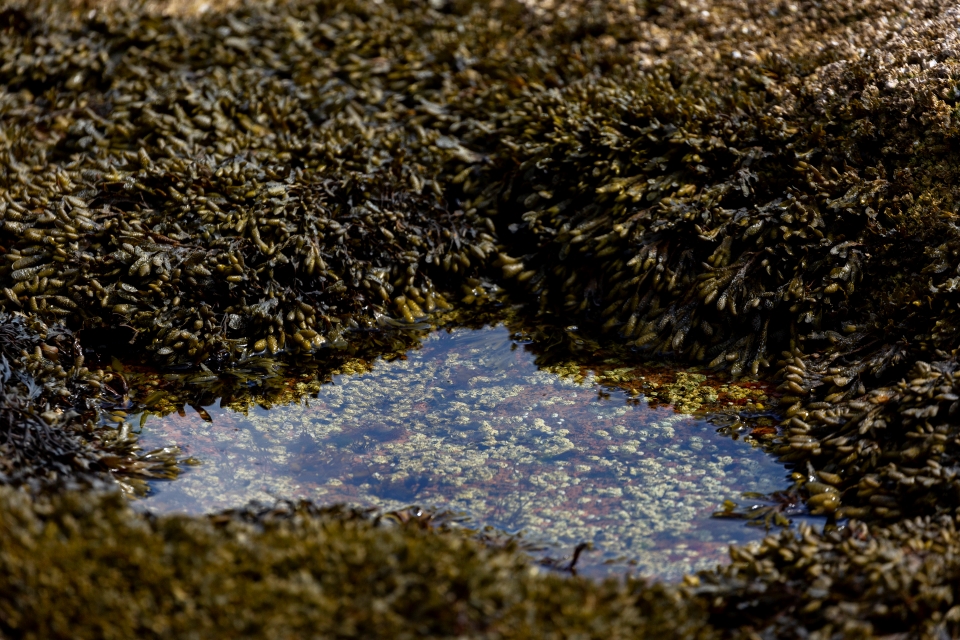
Rockweed (Fucus spp.) coating rocks in the intertidal zone at Thunder Hole. Photo by Ashley L. Conti, Friends of Acadia, NPS.
Marine Algae and Seaweeds
Though technically not plants but photosynthetic protists, seaweeds form a crucial component of Acadia's coastal ecosystems. Rockweed (Fucus spp. and Ascophyllum nodosum) dominates the intertidal zone, creating critical habitat for numerous marine invertebrates. When exposed at low tide, its air bladders help the fronds float upright when the tide returns, maximizing photosynthetic surface area. According to the National Park Service, "Rockweed is a prevalent coastal plant that has significant value to researchers, commercial ventures, and tidepool enthusiasts."
Irish Moss (Chondrus crispus), despite its name, is actually a red algae that forms low, carpet-like growths in the lower intertidal and subtidal zones. Its deep reddish-purple fronds become bleached and take on a greenish hue when exposed to intense sunlight. This species has commercial importance as a source of carrageenan, a thickening agent used in many food products.
Kelps (various species) are large brown algae that typically grow in deeper water beyond the intertidal zone. However, storms often detach these impressive seaweeds and wash them ashore, where they contribute important nutrients to beach ecosystems as they decompose. The holdfasts that anchor kelp to rocky substrates often wash up intact, revealing complex microhabitats that supported numerous small marine creatures.
Coastal Trees and Shrubs
The immediate shoreline transitions quickly to woody vegetation in many parts of Acadia. White Spruce (Picea glauca) is particularly well-adapted to coastal conditions, developing a distinctive wind-pruned, flag-like shape in exposed locations. As the National Park Service notes, "Evergreens trees like red spruce, white spruce, and balsam fir characterize the canopy of this coastal forest." These trees create the iconic Maine coastal landscape that has inspired artists and photographers for generations.
Northern Bayberry (Morella pensylvanica) is a salt-tolerant shrub with aromatic leaves coated in a waxy substance that helps reduce water loss and protect against salt damage. Early settlers used the waxy berries to make fragrant bayberry candles, a tradition that continues in some coastal communities today.
Pitch Pine (Pinus rigida) represents one of the most resilient tree species in coastal areas, capable of growing in extremely poor, sandy soils where few other trees can survive. As the Friends of Acadia brochure notes, "Where drainage is good, shrubs such as huckleberry, shadbush, bush-honeysuckle, sweet-fern, and chokeberry may grow. Fire maintains this type of woodland, and pitch pines are adapted to it. They can re-sprout after a fire and, as a result, sometimes assume a natural bonsai shape."
Discover Coastal Plants: Field Guide to Coastal Plants (Amazon)Seasonal Changes in Coastal Vegetation
One of the most fascinating aspects of Acadia's coastal vegetation is how dramatically it changes throughout the seasons. Each visit to the same shoreline location reveals a different face of these dynamic plant communities, making repeat visits rewarding for naturalists and photographers alike.
Spring Awakening (April-May)
The coastal vegetation of Acadia emerges from winter gradually, often several weeks behind inland areas due to the moderating but cooling influence of the ocean. Early spring along the coast is characterized by subtle changes—the first hint of green in salt marsh grasses, the emergence of new leaves on bayberry shrubs, and the early growth of beach pea vines sprawling across upper beach areas.
In protected coves and salt marsh edges, look for the earliest coastal wildflowers like Seaside Plantain beginning to send up their distinctive flower spikes. Spring is also when many rare plants begin to emerge on coastal headlands, though they often don't flower until later in the season.
Seaweeds reach peak growth during spring as increasing daylight fuels their photosynthesis before summer water temperatures rise too high. The intertidal zone becomes increasingly lush with rockweeds and other marine algae developing new growth at their tips.
Summer Bloom (June-August)
Summer brings Acadia's coastal vegetation into its full glory. By mid-June, the Beach Pea produces its striking purple flowers along sandy areas, while Sea Lavender begins to create waves of lavender-colored blooms in salt marshes by July. The coastal headlands come alive with specialized plants in bloom, including the rare Beachhead Iris with its delicate blue-purple flowers.
August marks the beginning of Seaside Goldenrod's magnificent display, which will continue into fall. Its bright yellow flower spikes create dramatic contrast against the blue ocean backdrop. The summer months are ideal for botanizing along Acadia's shore, as the greatest diversity of species are visible and identifiable.
The coastal coniferous forests take on a deep, rich green during summer, with new growth on spruce and fir trees creating a lighter green accent against the darker mature needles. As noted in the Acadia National Park materials, "The coastal CONIFEROUS WOODS of Acadia National Park say 'Maine.' Lichen-clad red spruce, white spruce, and balsam fir cling to coastal rocks that are only thinly covered with soil."
Fall Transitions (September-November)
While Acadia's famous fall foliage is most dramatic inland, the coastal vegetation has its own autumn character. Seaside Goldenrod continues its spectacular bloom well into October, providing crucial late-season nectar for migrating butterflies. Salt marsh grasses take on golden and russet hues as they prepare for dormancy.
Along rocky shorelines, the low-growing plants of the headlands often develop surprising fall color, with species like Three-toothed Cinquefoil turning brilliant red. According to the Schoodic Institute research, "As the coast continues to experience pressure from changing land uses amid a changing climate," these fall transitions may shift in timing and character over coming decades.
Fall storms bring dramatic changes to the intertidal zone, often tearing loose large quantities of kelp and other seaweeds that form wrack lines along the shore. These decomposing marine plants provide critical nutrients for coastal ecosystems and support diverse invertebrate communities that in turn feed shorebirds.
Winter Resilience (December-March)
Winter reveals the remarkable adaptations of Acadia's coastal plants to extreme conditions. The evergreen coastal forest stands in stark contrast to deciduous inland areas, maintaining its deep green presence despite snow and ice. Wind-sculptured spruces demonstrate their remarkable resilience to coastal winter storms.
Many coastal perennial plants survive winter with their resilient root systems safely below ground while their above-ground portions die back completely. The architectural remnants of salt marsh grasses and seaside goldenrod stems create a beautiful winter landscape, especially when highlighted by snow or ice.
Even in winter, the intertidal zone remains alive with hardy seaweeds that can withstand freezing temperatures during low tide exposure. The perennial rockweeds may lose some of their fronds to ice scouring but maintain their holdfasts to regrow when conditions improve.
Video: Outside Science - Tidepools in Acadia National Park. Credit: National Park Service
My Experience: A Ranger's Perspective
James Peterson
Former Seasonal Interpretive Ranger, Acadia National Park
During my five seasons as an interpretive ranger at Acadia, I developed a special connection with the park's coastal plant communities. Leading weekly "Shoreline Explorer" walks allowed me to witness these dynamic ecosystems across all seasons and weather conditions—each experience revealing something new about how plants adapt to life at the ocean's edge.
One particularly memorable experience occurred during an unusually low spring tide following a nor'easter. As our small group explored the exposed intertidal zone near Otter Point, we discovered an incredible diversity of seaweeds normally hidden beneath the waves. I'll never forget the wonder on visitors' faces as we carefully examined the intricate structure of Irish moss and the surprisingly slippery texture of kelp holdfasts—connections to the marine world that many had never experienced before.
Another transformative moment came while monitoring a rare population of roseroot sedum on an exposed headland near Great Head. This Arctic-alpine species reaches the southern limit of its range in Acadia, clinging to life in crevices where few other plants can survive. After discovering that a small unofficial trail had developed dangerously close to these plants, I worked with the resource management team to subtly redirect foot traffic with strategically placed rocks. Two years later, the population had noticeably expanded—a small conservation victory that demonstrated how even minor interventions can make a meaningful difference.
My advice for visitors hoping to experience Acadia's coastal vegetation? First, timing is everything—mid-July through early September offers the greatest diversity of flowering species. Second, don't just focus on the obvious coastal trail sections; some of the most interesting plant communities exist in less-trafficked areas like Schoodic Peninsula and Isle au Haut. Finally, bring a good hand lens or magnifying glass—many coastal plants have fascinating adaptations visible only at close range, from the salt-excreting glands on seaside plantain leaves to the intricate cellular structure of seaweeds.
After years of observing these shoreline plants, I've developed tremendous respect for their resilience. Whether enduring salt spray, surviving winter ice scour, or growing in seemingly impossible rock crevices, Acadia's coastal vegetation represents nature's ingenuity at its finest—a daily reminder of life's remarkable capacity to adapt and thrive even in the harshest conditions.
Essential Field Guides
Over my years at Acadia, I found these field guides indispensable for identifying coastal vegetation:
- The Plants of Acadia National Park by Glen H. Mittelhauser et al. - The most comprehensive guide specific to Acadia
- Coastal Plants from Cape Cod to Cape Canaveral - Excellent for identifying shoreline species
- Field Guide to Coastal Wetland Plants - Perfect for salt marsh identification
Conservation Challenges and Efforts
Acadia's coastal vegetation faces numerous threats in the 21st century, from climate change to invasive species to human impacts. Understanding these challenges and the conservation efforts addressing them is essential for anyone who values these unique plant communities.
Climate Change Impacts
Sea-level rise represents perhaps the most significant threat to Acadia's coastal plant communities. According to USGS research on salt marsh migration in Acadia, rising waters are already causing measurable changes in vegetation patterns. As saltwater pushes inland, freshwater-dependent species retreat while salt-tolerant plants advance—a process called "coastal squeeze" when development or steep topography prevents natural migration.
Increased storm intensity also threatens coastal vegetation through enhanced erosion, storm surge, and salt spray deposition further inland than plants are adapted to tolerate. The Schoodic Institute's research emphasizes that "as the coast continues to experience pressure from changing land uses amid a changing climate, there is a need...to map and track changes in the distribution and abundance of coastal vegetation habitats."
Ocean acidification, while primarily affecting marine organisms, may indirectly impact coastal vegetation by altering the intertidal communities that interact with shoreline plants. Changing pH levels could disrupt the delicate balance of species that has evolved in these transitional zones.
Invasive Species Concerns
Invasive plant species pose a particular threat to Acadia's native coastal vegetation. As Friends of Acadia notes, "In Acadia, the presence of invasive plants is relatively low compared to other protected areas in the northeast." However, this relative success is due to aggressive management rather than absence of threat. Species like Asiatic Bittersweet and Japanese Knotweed can quickly overwhelm native coastal vegetation if left unchecked.
Even some popular ornamental plants used in nearby coastal landscapes can become problematic. Rosa rugosa (Beach Rose), while beloved for its fragrant flowers and hardy nature, has become invasive in some coastal areas, displacing native dune vegetation. Visitors are sometimes surprised to learn that this seemingly "natural" part of the Maine coast is actually an introduced species from Asia.
The National Park Service's Vegetation Management Program focuses on "documenting and understanding the park's flora, protecting rare species, monitoring and controlling invasive plants," demonstrating the priority placed on maintaining native plant communities.
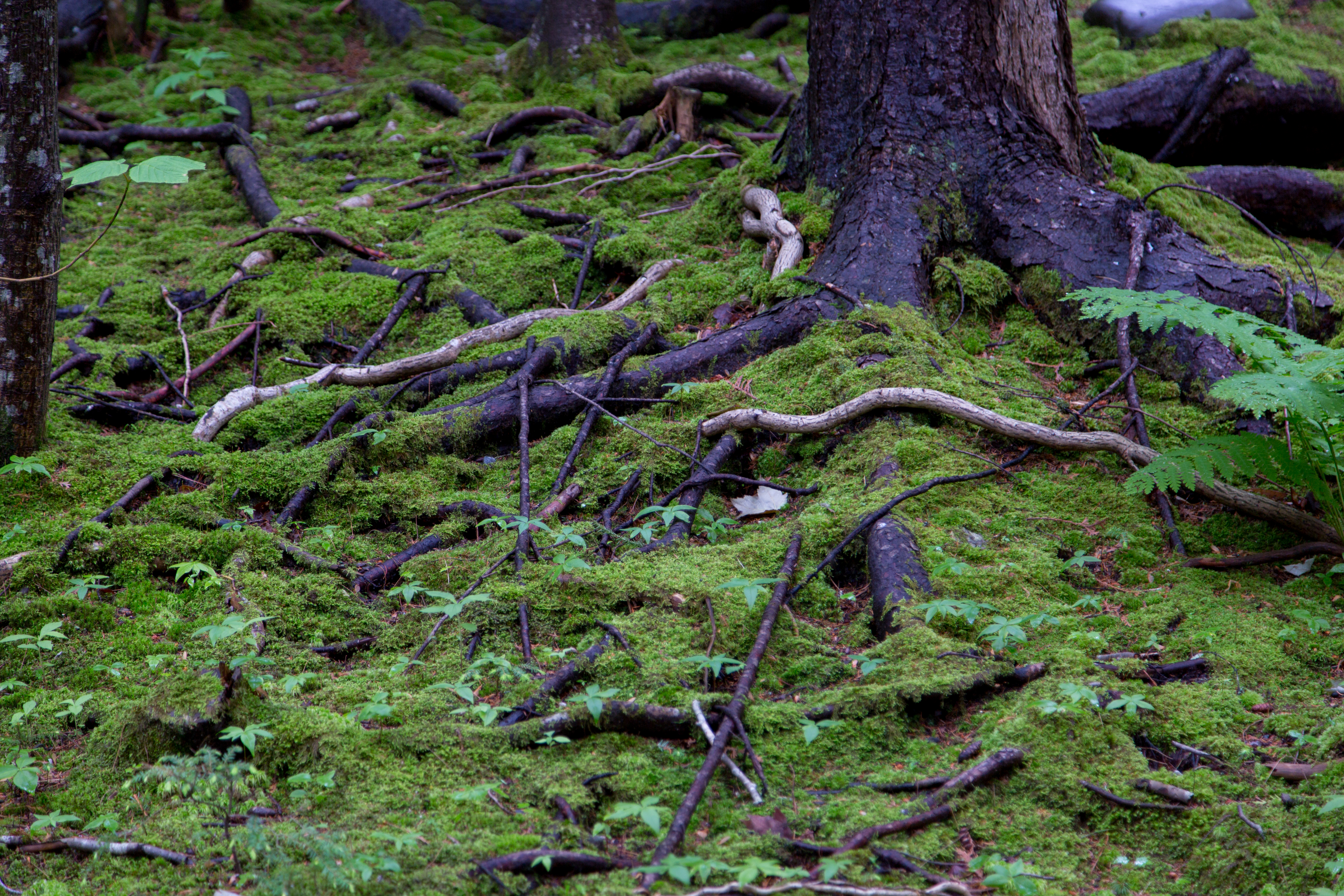
Roots and moss along a forest floor in Acadia. Photo by Nathaniel X. Bochat, Friends of Acadia, NPS.
Visitor Impact Management
With over 4 million visitors annually, human impact on Acadia's fragile coastal vegetation presents a significant management challenge. Trampling of sensitive plants, soil compaction, and the creation of unofficial "social trails" all threaten plant communities that may have taken decades to establish on thin coastal soils.
The park has implemented several strategies to protect coastal vegetation while still allowing visitors to experience these unique environments. Boardwalks in sensitive areas protect underlying vegetation and soil structure while keeping visitors on designated routes. Educational signage helps visitors understand the importance and fragility of coastal plant communities.
According to park botanists, even minor disturbances can have lasting impacts on coastal headland vegetation, where plants grow extremely slowly due to harsh conditions. A single footstep off-trail can damage plants that might take years to recover, if they recover at all.
Conservation Success Stories
Despite these challenges, there are notable conservation successes worth celebrating. The Wild Gardens of Acadia at Sieur de Monts Spring showcases native coastal plants in naturalistic settings, helping visitors identify and appreciate species they might encounter along the shore. As their brochure notes, the gardens include "several uncommon coastal headland plants: roseroot sedum and arctic blue flag iris."
Collaborative research between the National Park Service, Schoodic Institute, and academic partners has dramatically improved understanding of coastal vegetation dynamics. The Coastal Vegetation Spectral Library project represents a cutting-edge approach to monitoring these communities using drone-based remote sensing combined with ground surveys.
Volunteer efforts through Friends of Acadia have contributed thousands of hours toward invasive plant removal and habitat restoration. Their "Acadia's 35+ Year Invasive Plant Management Program" demonstrates the value of consistent, long-term commitment to conservation.
Community Perspectives: Visitor Reviews
"As an amateur botanist, I was blown away by the diversity of plant life along Ocean Path. The way seaside goldenrod clings to seemingly impossible rock crevices is incredible. Bring a field guide and take your time—there's so much easy to miss if you're just focused on the ocean views."
— Maria T., Reddit r/acadianationalpark
"The Wild Gardens of Acadia is a must-visit for plant enthusiasts. I learned more about coastal vegetation in an hour there than I did in days of hiking. The volunteers were knowledgeable and passionate about explaining how these plants adapt to coastal conditions. It gave me a much better eye for spotting these species in the wild."
— James K., Amazon review of "Plants of Acadia National Park"
"Don't miss Wonderland Trail on the 'quiet side' of the island if you're interested in coastal plants. Less crowded than the eastern shore trails, and the low-tide pools are surrounded by fascinating salt-tolerant plants. We saw three different species of seaweed we hadn't encountered elsewhere in the park."
— Sarah M., Quora response
Frequently Asked Questions
What is the best time of year to see coastal wildflowers in Acadia?
The optimal time to observe Acadia's coastal wildflowers is from mid-July through early September. This period captures the blooming of iconic species like Sea Lavender, Beach Pea, and Seaside Goldenrod. Early August typically represents the peak of diversity, with multiple species in bloom simultaneously. For photography enthusiasts, the golden hour light of early morning or late afternoon creates dramatic lighting conditions that enhance the contrast between colorful blooms and the blue ocean backdrop.
Are there any rare or endangered coastal plants I should look for?
Acadia National Park harbors several rare coastal plant species worth seeking out, though conservation ethics dictates observing rather than collecting these treasures. Roseroot Sedum (Rhodiola rosea) and Beachhead Iris (Iris setosa) are uncommon species found on coastal headlands, representing Arctic-alpine plants at the southern limit of their range. The Maine Natural Areas Program identifies approximately 25 state-listed rare plants within park boundaries, many concentrated in coastal habitats. When exploring, stay on designated trails to protect these sensitive species, and consider joining a ranger-led program that highlights these special plants while emphasizing conservation.
How is climate change affecting Acadia's coastal vegetation?
Climate change impacts on Acadia's coastal vegetation are increasingly evident through several mechanisms. Sea-level rise is causing "coastal squeeze" of salt marshes and other shoreline plant communities, particularly where steep topography or development prevents inland migration. Warmer ocean temperatures are altering the composition of intertidal seaweed communities, with some cold-water species declining. Increased storm intensity and frequency subject coastal plants to greater physical damage and salt spray deposition. The park's science program, in partnership with the Schoodic Institute, is actively monitoring these changes using both traditional field surveys and innovative technologies like drone-based remote sensing to track vegetation shifts over time.
What coastal trail has the best vegetation diversity?
The Ship Harbor Nature Trail offers arguably the best coastal plant diversity in a relatively short (1.3-mile) figure-eight loop. This trail on the western side of Mount Desert Island showcases multiple coastal habitats, from spruce-fir maritime forest to rocky shoreline to protected cove vegetation. The interpretive signs along the trail provide excellent identification tips for common species. For those seeking a less-traveled alternative, the Wonderland Trail nearby offers similar diversity with typically fewer visitors. On Schoodic Peninsula, the East Trail passes through exceptional headland plant communities, including some of the park's best examples of roseroot sedum and other specialized coastal species.
Can I harvest any edible coastal plants or seaweeds in Acadia?
National Park Service regulations prohibit collecting or removing any natural objects within Acadia National Park, including plants, seaweeds, shells, and rocks. This protection ensures that these resources remain available for all visitors to enjoy and for the ecosystem to function naturally. However, several local businesses offer sustainably harvested seaweeds from nearby waters outside the park, including dulse, kelp, and Irish moss products. If you're interested in wild edibles, consider joining an educational program led by local experts who can provide identification skills and sustainable harvesting practices applicable outside protected areas. Alternatively, the local farmers' markets often feature vendors selling locally-harvested seaweed products.
Conclusion
The coastal vegetation of Acadia National Park represents one of the most remarkable ecological treasures of the Atlantic seaboard. From the marine algae clinging to wave-battered rocks to the wind-sculptured spruces defining the iconic Maine shoreline, these plant communities tell a story of remarkable adaptation and resilience. As we've explored throughout this guide, Acadia's position at the intersection of northern and southern biogeographical regions creates a unique assemblage of species found nowhere else along the coast.
Understanding these coastal plant communities enriches any visit to Acadia. The ability to identify key species and recognize the ecological patterns along the shore transforms a casual walk into a deeper connection with the landscape. Whether you're admiring the golden blooms of Seaside Goldenrod against a September sky or discovering the intricate adaptations of rockweed during a low tide exploration, the coastal vegetation adds layers of meaning to Acadia's famous scenery.
Yet these precious plant communities face unprecedented challenges. Climate change, invasive species, and human impacts all threaten the delicate balance that has evolved along Acadia's shores over thousands of years. Conservation efforts by the National Park Service and partner organizations like Friends of Acadia and the Schoodic Institute provide hope that these botanical treasures will remain for future generations to study and enjoy.
As visitors to this remarkable landscape, we each have a responsibility to tread lightly and practice good stewardship. By staying on designated trails, learning to identify and appreciate native species, supporting conservation organizations, and sharing our knowledge with others, we contribute to the preservation of Acadia's coastal botanical heritage.
In the words of Acadia's first superintendent, George B. Dorr: "The beauty of the parks is not alone in the things seen—trees, flowers, lakes, hills and sea—but in their combination, in their succession, in their setting, and in the atmosphere that enfolds them." The coastal vegetation of Acadia exemplifies this interconnected beauty, inviting us to look more closely, learn more deeply, and care more passionately about this extraordinary meeting place of land and sea.
Explore More About Acadia's Plant Communities
Discover the full diversity of plant life throughout Acadia National Park: